Green Dot (Grüner Punkt) Kang Hao certification
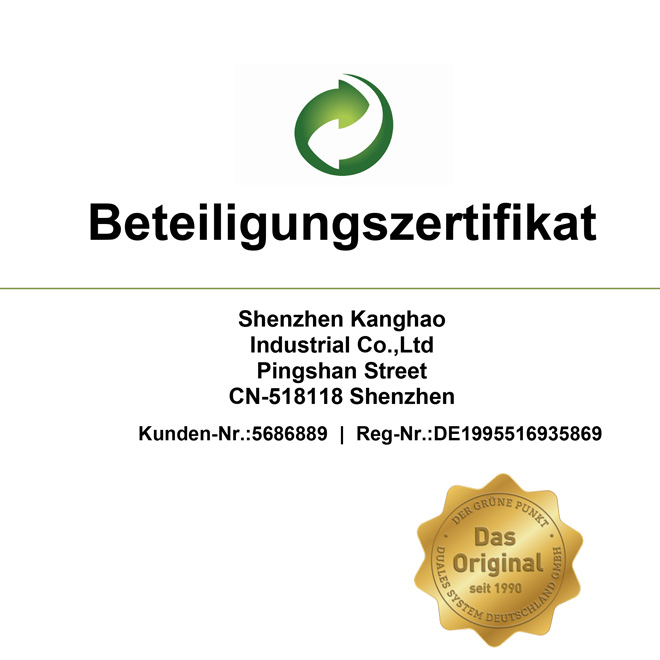
Kang Hao has past Green Dot (Grüner Punkt) certification

The Green Dot (German: Der Grüne Punkt) is the license symbol of a European network of industry-funded systems for recycling the packaging materials of consumer goods. The logo is trademark protected worldwide.
History of "Grüner Punkt"
The German "Grüner Punkt" is considered the forerunner of the European scheme. It was originally introduced by Duales System Deutschland GmbH (DSD) in 1990 before the introduction of a Packaging Ordinance under the Waste Act. Since the successful introduction of the German industry-funded dual system, similar Green Dot systems have been introduced in most other European countries.
The Green Dot scheme is covered under the European "Packaging and packaging waste directive - 94/62/EC", which is binding on all companies if their products use packaging and requires manufacturers to recover their own packaging. According to the directive, if a company does not join the Green Dot scheme, they must collect recyclable packaging themselves, although this is almost always impossible for mass products and only viable for low-volume producers. Regulatory authorities in individual countries are empowered to fine companies for non-compliance, although enforcement varies by country. Environmentalists claim that some countries deliberately turn a blind eye to the European directive.
Since its European introduction, the scheme has been rolled out to 23 European countries. In some — namely France, Turkey, Spain, Portugal and Bulgaria — companies joining the Green Dot scheme must use the logo.
The Green Dot is used by more than 130,000 companies, encompassing 460 billion packages.