Custom Color Options
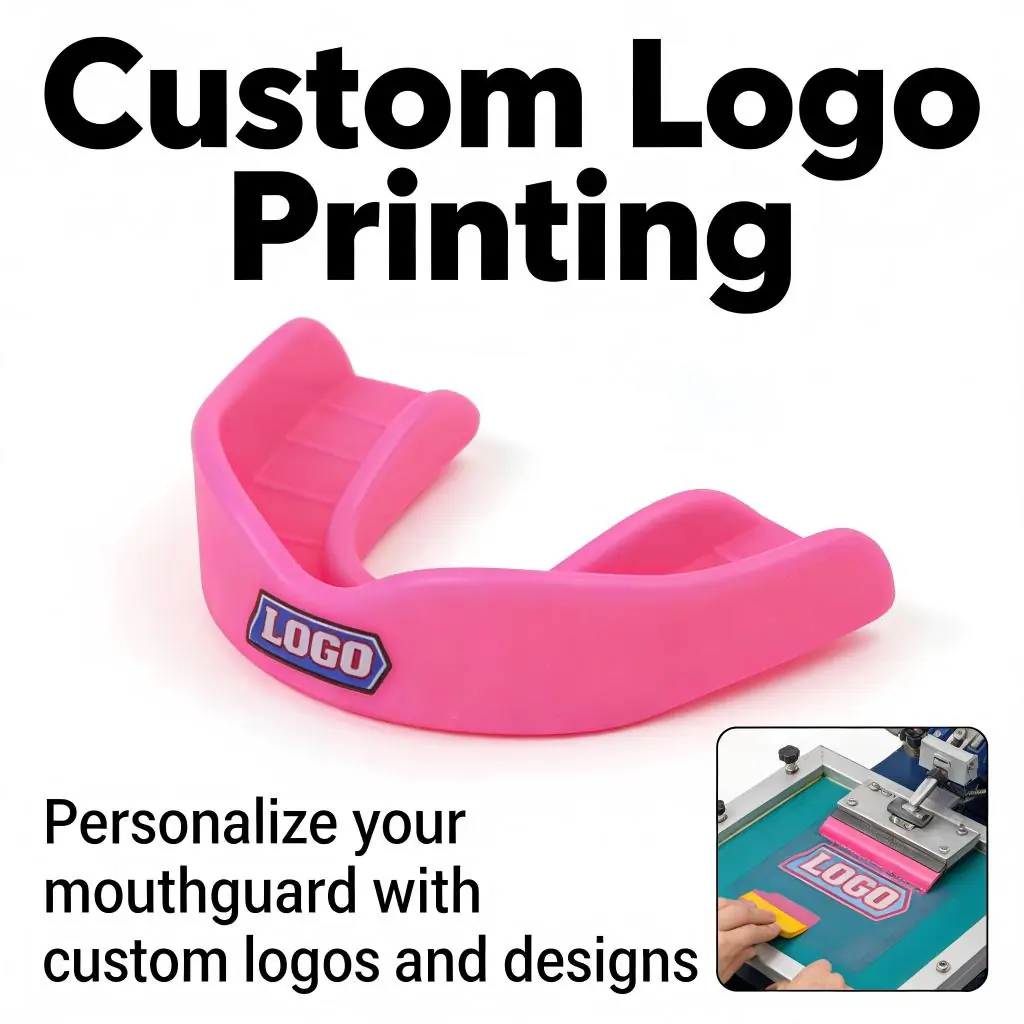
A sports mouthguard works by placing a layer of soft plastic between the upper and lower arch, so a direct hit is partly absorbed and spread instead of landing on a single tooth edge. A single-color EVA guard does that with one EVA compound and one pigment — no second layer, no printed film, no gradient. It is the least complicated way to put a protective mouthguard on a shelf or in a team bag, and for a lot of buyers it is also the most profitable.
This guide is written for brand owners, club buyers and distributors who need to specify, test and reorder the product. It covers what “single color” actually means next to “single layer”, the numbers to put on a purchase order, the seven production steps, what the November 2025 laboratory reports do and do not prove, and how a private-label run is quoted by Shenzhen Kanghao Industrial Co., Ltd.

Single-color EVA guards are molded in one shade. Team colors are matched to Pantone, not printed on top.
What “Single Color” Means — and Why It Is Not the Same as “Single Layer”
EVA is an ethylene-vinyl acetate copolymer. The vinyl acetate (VA) content decides how soft the finished guard feels: a lower VA grade behaves more like firm plastic, a higher VA grade behaves more like rubber. Mouthguard sheet usually sits somewhere in the middle of that range, and the exact figure is one of the first things a factory will ask you about, because it changes both the bite feel and the molding window.
Single color is a color specification: one pigment batch, one shade, no gradient and no printed skin. Single layer is a structural specification: one sheet of material, one wall thickness. The two are often used interchangeably in catalog copy, but they are independent. A two-layer guard can be molded in a single color, and a single-layer guard can carry a printed logo. Confusing them is the most common reason a sample comes back looking nothing like the reference photo.
In practice, three builds dominate this category:
- Thermoformed single-layer sheet. An EVA blank is softened in hot water and bitten into shape by the athlete. This is the “boil and bite” route, cheap to tool, fast to sample, and the standard for club and school supply.
- Injection-molded single-layer. Pellets are molded directly into a pre-shaped arch. Cavity cost is higher, but unit cost drops at volume and the shape is identical every time.
- Single-color, multi-layer. Two EVA grades bonded for hardness control, both pigmented the same shade. Buyers choose this when they want the performance of a dual-density build without the two-tone look.
As a mouthguard manufacturer in Shenzhen, Kanghao's standard offering in this family is a food-grade EVA, single-layer guard with custom color and custom logo — see the Custom Single Layer EVA Sports Mouthguard for the base specification, or browse the full sports mouth guards category if you are comparing builds before choosing.
Why Single-Color Still Wins for Clubs, Schools and Private Labels
A single-color guard is not a downgrade. It is a deliberate choice, and in four situations it outperforms a printed or dual-tone product on total cost of ownership.
It looks clean on the field
Solid black, clear, white or a single team color reads as equipment rather than merchandise. There is no cartoon print to date the product, no oversized logo that clashes with a club kit, and no color layer that separates after a season of use. For a school or a league buying two hundred units, that neutrality is the point — one SKU covers every team.
Staining and wear are less obvious
Multi-color guards show discoloration along the bite line within weeks, because two pigments age at different rates and the seam traps residue. A single shade, especially a darker one, hides grind marks, saliva staining and the fine scratches that come from case abrasion. The product looks sellable for longer, which matters if you are holding inventory across a season.
Damage is easier to inspect
With one uniform color, a coach or a parent can see a crack, a chewed edge or a thinning bite platform immediately. Patterns and printed skins hide exactly the defects you need to catch. Any equipment manager who has pulled a split guard out of a bag will recognize the value of that.
There is nothing to delaminate or peel
A printed logo can lift. Two co-extruded layers can separate at the interface if the bond is marginal. A single-color, single-layer guard has neither failure mode: the color runs through the material, so a scuff does not turn into a white patch, and there is no interface to fail.
| Criterion | Single-color, single-layer | Dual-color, dual-layer |
|---|---|---|
| Tooling and sample cost | Low | Higher (two compounds, bonding step) |
| Unit cost at 1,000+ pcs | Lowest | Higher |
| Impact management | Good for training and school sport | Better force spreading at the outer shell |
| Visual wear over a season | Low, hides staining well | Higher, seam and two-tone aging |
| Logo options | Print, emboss, laser | Print, emboss, plus color-coded layers |
| Best fit | Club supply, promotional, entry retail | Branded performance line, combat sports |
The honest summary: if your buyers are schools, clubs and municipal programs, single-color is the right commercial answer. If you are building a performance line for boxing or MMA and the retail story depends on a hard outer shell, the double layer sport mouth guard is the better starting point — and the difference is explained in more depth in the existing article on why dual-layer hard and soft EVA mouthguards perform better.
The Spec Sheet to Attach to a Purchase Order
Most quality disputes in this category come from a PO that says “mouthguard, black, 500 pcs”. Vague orders get whatever the factory had on the line. The following fields are the ones that actually change what arrives in the carton; the values shown are typical industry ranges, so confirm them against your own sample before you sign.
| Field | Typical range | What to write on the PO |
|---|---|---|
| Material | Food-grade EVA copolymer | “Food-contact EVA, no recycled content, no phthalate plasticizer” |
| VA content | Mid-range copolymer grade | Ask the factory to state the VA percentage and hold it across reorders |
| Wall thickness | 2–4 mm, thicker at the bite platform | Nominal thickness plus tolerance, e.g. 3.0 mm ± 0.2 mm |
| Hardness | Soft to semi-firm Shore A | Shore A target with a tolerance band, measured on the flat blank |
| Size | Adult, youth, braces-compatible | Size chart with arch width in mm, not just “adult” |
| Color | Pantone or physical master | Pantone reference plus “match to approved sample, ΔE ≤ 1.5” |
| Logo | Print, emboss or laser | Artwork file, placement drawing, minimum line width |
| Packaging | Poly bag, blister, color box, case | Case color, insert card, barcode and carton mark |
| Documentation | Test reports, declaration | Which reports travel with the shipment, in which language |
Two fields are consistently under-specified. The first is thickness tolerance: a 3 mm nominal guard that runs 2.6 mm at the bite platform loses exactly the material that does the work. The second is color approval: “black” is not a specification. Ask for a physical master or a Pantone number, and put the approved sample number on the PO so a reorder cannot drift.
How a Single-Color EVA Mouthguard Is Made: Seven Steps
Production is simple in outline and fussy in the details. Each step below includes the failure mode worth watching for on an audit.
1. Compound and pigment preparation
EVA pellets are dried and blended with a pigment masterbatch, then checked for moisture and melt flow. Moisture is the classic defect source: damp pellets produce silver streaks and internal voids that only show up after molding. A factory that does not record drying time and dew point is guessing.
2. Sheet extrusion or direct injection
For thermoformed blanks, the compound is extruded into sheet of controlled thickness, then slit to width. For injection-molded guards, pellets go straight into the cavity. In both cases the color is locked in at this step — you cannot correct a shade after molding, only scrap the batch.
3. Pre-heating
The blank or preform is brought to forming temperature in a water bath or oven. Under-heating leaves spring-back and a guard that will not hold its shape on the arch; over-heating degrades the surface and can release the pigment unevenly.
4. Forming
The softened material is drawn over a dental arch model or into a shaped cavity under vacuum or pressure. Wall thickness distribution is decided here: material flows away from the palate and toward the bite platform, so the tool design has to compensate or the platform ends up thin exactly where impact lands.
5. Trimming and edge finishing
Flash is removed and the border is rounded. A sharp edge is the single most common complaint from end users, and it is entirely a finishing problem — the material is fine, the trim is not.
6. Annealing and relaxation
The formed guard is held at a controlled temperature to relax internal stress. Skipped or rushed, this step produces guards that warp in a hot car or a shipping container, and the deformation appears after the goods have left the factory.
7. Final inspection and packing
Thickness measurement, fit check on a standard arch, color comparison to the approved master, weight check and visual inspection under controlled light. Only then does the guard go into its bag or case.
Compliance: What the November 2025 Reports Cover — and What They Do Not
Two laboratory reports were issued for a braces-type EVA sample submitted by Shenzhen Kanghao Industrial Co., Ltd. in November 2025, both by Guangdong Wonder Testing International Co., Ltd. Understanding their scope is more useful than the pass stamps themselves.
Report WDX2510586EN-1 (13 November 2025) covers US FDA 21 CFR 177.1350, the regulation for ethylene-vinyl acetate copolymers in food-contact use, testing chloroform-soluble extractives in distilled water. Result: pass.
Report WDX2510586EN-2 (17 November 2025) covers five European and German requirements:
| Test item | Standard | Result |
|---|---|---|
| Sensory examination, odour and taste; peroxide value | German LFGB, sections 30 and 31 | Pass |
| Overall migration | EU 1935/2004 and EU 10/2011 | Pass |
| Lead (Pb) content | REACH Annex XVII, entry 63 | Pass |
| Cadmium (Cd) content | REACH Annex XVII, entry 23 | Pass |
| PAH content, category 2 | AfPS GS 2019:01 PAK | Pass |
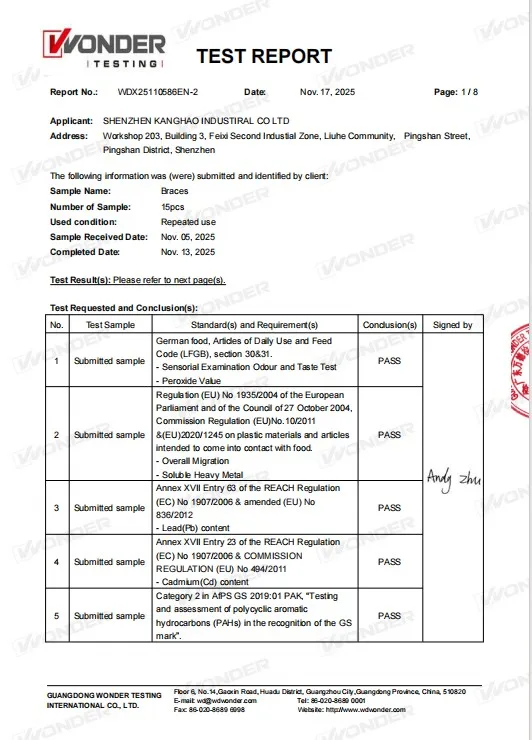
Report WDX2510586EN-2, issued 17 November 2025: five European and German test items, all passed.
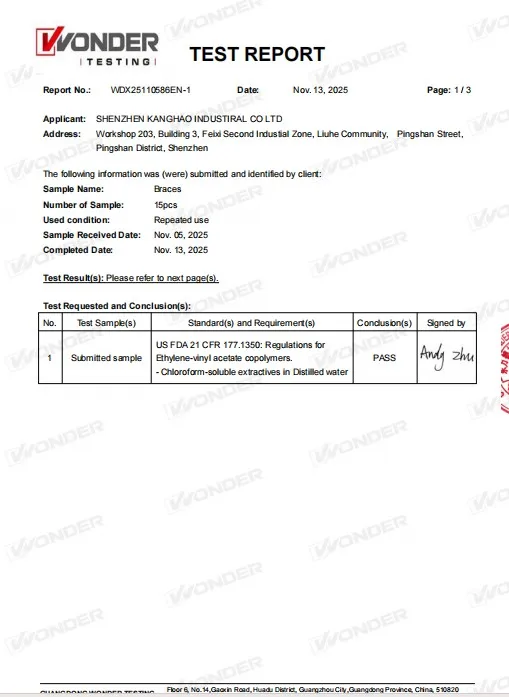
Report WDX2510586EN-1, issued 13 November 2025: FDA 21 CFR 177.1350 extractives test, passed.
What this establishes is material safety for oral and food-contact use: the compound does not release excessive migration, does not carry lead or cadmium above the REACH limits, does not carry PAHs above the GS category 2 limits, and does not produce an off-taste or off-odour. For a product that sits in someone's mouth for an hour at a time, those are the tests that matter most, and they are the ones a distributor's compliance team will ask for first.
What the reports do not establish is equally important, and buyers are frequently surprised by it:
- They are not an impact-performance test. Nothing in either report measures force attenuation, retention on the arch or resistance to tearing. If your marketing claims a protection level, you need a separate drop-impact or retention protocol, and you need to define the acceptance criteria yourself.
- They are not a CE certificate for protective equipment. If a guard is sold in the EU as protective equipment, Regulation (EU) 2016/425 applies and CE marking requires notified-body involvement. A material test report sits underneath that process; it does not replace it. The factory publishes a CE certificate for EVA sports mouthguards on its certificate page, and the right move is to request the declaration of conformity and confirm which regulation it was issued under before you print CE on a retail box.
- They are not a medical device approval. A mouthguard is not a therapeutic device, and no report here should be read as a dental or medical claim.
- They do not cover every market. US, EU, UK, Australian and Gulf importers each ask for a different document set, and requirements change. Treat the reports as the material-safety foundation and confirm the rest with your importer.
One practical note on the sample itself: the submitted item was logged as “Braces”, 15 pieces, received 5 November and completed 13 November 2025. If you are sourcing a standard adult guard rather than a braces-compatible one, ask whether the report is representative of that construction or request a report for your specific build.
Pre-Shipment QC: The Checks That Catch a Bad Batch
A single-color guard has nowhere to hide a defect, which makes final inspection straightforward. The following checklist is worth writing into the order:
- Thickness: measured at the bite platform on a sample from every carton; the platform is the load-bearing area, not the palatal flange.
- Weight: a fast proxy for missing material; a guard that is 8% light is usually 8% thin.
- Color: compared under D65 lighting against the approved master, with a documented ΔE limit.
- Boil-and-bite trial: 60 seconds in hot water, then formed on a standard arch; check for spring-back, surface tack and pigment bleed.
- Fit and retention: the formed guard should stay on the arch without finger pressure and should not rock.
- Edge finish: a visual and tactile pass along the full border; sharp edges are a return driver.
- Staining spot check: a cut section soaked in coffee or cola for 24 hours, then compared to an untreated control.
- Packaging: seal integrity on bags, print registration on boxes, barcode scan and carton drop test.
- Sampling plan: AQL 2.5 on major defects and AQL 1.0 on critical defects is the usual commercial split, with the inspection record travelling with the shipment.
Thickness and weight are the two measurements that catch the most problems per minute spent, because both trace back to the forming step and both are invisible in a photograph.
Customization, MOQ and Lead Times
A single-color product is not a single-option product. What changes between buyers is everything around the material: the custom logo, the case, the retail packaging, and the wholesale quantity behind the order.
Colors. Pantone matching on the compound is standard for wholesale orders. Very light shades and transparent tints are harder, because pigment loading that high starts to affect the molding window, so expect a small minimum on a pale or crystal-clear run.
Logos. Pad printing gives the sharpest edge on a curved surface and is the usual choice for a compact mark. Silkscreen suits larger flat areas. Embossing is the most durable option because the mark is formed into the material and cannot wear off, and laser marking works well on darker shades. All three survive dish-soap washing; none survive a dishwasher cycle indefinitely, and that should be stated on the retail pack.
Sizes. Adult, youth and braces-compatible arches are the three that cover most orders. Braces versions need a deeper relief channel, which changes the tool, so they are worth ordering as a separate line rather than a variant.
Cases and packaging. A hinged vented case is the default accessory; custom case color, printed insert card, hang tag, blister and shrink-wrap are all available. The packaging decision usually determines the retail price point more than the guard itself does.
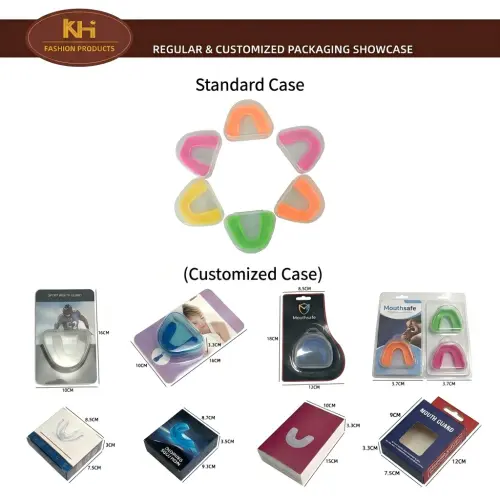
Case color, insert card, blister and printed box are chosen per order - packaging usually sets the retail price point.
MOQ and timing. Small MOQ is accepted, with the exact figure depending on color, tooling and packaging — the factory quotes per project rather than publishing a single number. Sampling is typically 5 to 7 days and mass production 15 to 25 days after sample approval, with the caveat that a new mold or a custom Pantone adds time at the front. Air freight is normal for a first order; sea freight only pays once the volume justifies the transit.
If you are still at the stage of comparing materials rather than colors, the custom solutions page sets out how tooling and material selection are handled, and the factory page covers the molding and inspection equipment behind the quotes.
FAQ
Is a single-color guard as protective as a dual-layer one?
For training, school and club sport, a well-fitted single-layer EVA guard at the right thickness does the job it is bought for. A dual-density build spreads impact over a larger area because the outer shell is firmer, which is why combat sports brands tend to prefer it. The fit matters more than the layer count: a loose dual-layer guard protects worse than a properly fitted single-layer one.
Is EVA safe to keep in the mouth?
Food-contact grades are the relevant benchmark, and the November 2025 reports cover overall migration, heavy metals, PAHs, and odour and taste. Buyers should ask for the report that matches their own market and keep it on file. A mouthguard is not a medical device, and no supplier should describe it as one.
Can I put my logo on a single-color guard?
Yes — pad print, silkscreen, emboss or laser. Embossing is the most durable because the mark is molded into the surface. Send vector artwork and a placement drawing; curved surfaces distort fine detail, so a mark with thin strokes will need adjusting.
What thickness should I order?
Three millimetres at the bite platform is the common starting point for adult sport, with 2 mm for youth and 4 mm for heavy contact. Specify the measurement point as well as the number, because a 3 mm guard measured at the flange is a very different product from one measured at the platform.
Do you make braces-compatible versions?
Yes. The sample submitted for the November 2025 reports was a braces type, and the construction uses a relief channel to clear brackets and wires. It is quoted as a separate line because the tooling differs. For athletes already wearing fixed appliances, the Silicone Double Brace Sport Mouthguard is the alternative build worth comparing.
What documents come with a shipment?
Test reports, a material declaration, the approved sample reference and the packing list. Confirm the language and the exact report numbers on the PO, so the documents match what your importer expects at customs.
Can I see the guards being made before I commit?
A live video walkthrough of the molding line and the inspection bench is the usual alternative to a factory visit, and it is worth doing before a first tooling payment.
Choosing the Right Starting Point
Single-color EVA is the most efficient way to put a compliant, good-looking mouthguard into a club, school or entry-level retail program. Choosing a mouthguard factory comes down to whether it can state a thickness tolerance and hold a signed sample, not to the price list. Specify the material and the thickness properly, keep the test reports on file, inspect the bite platform rather than the photograph, and the product will reorder cleanly season after season.
For a wholesale quote, send the size, the color reference, the logo file and the packaging direction to the team through the contact page. If you want to compare structures first, the single layer clear sport mouth guard and the multi-layer adult and kids version sit on either side of the standard build, and the EVA mouthguard for boxing, MMA, rugby and taekwondo covers the contact-sport end of the range.