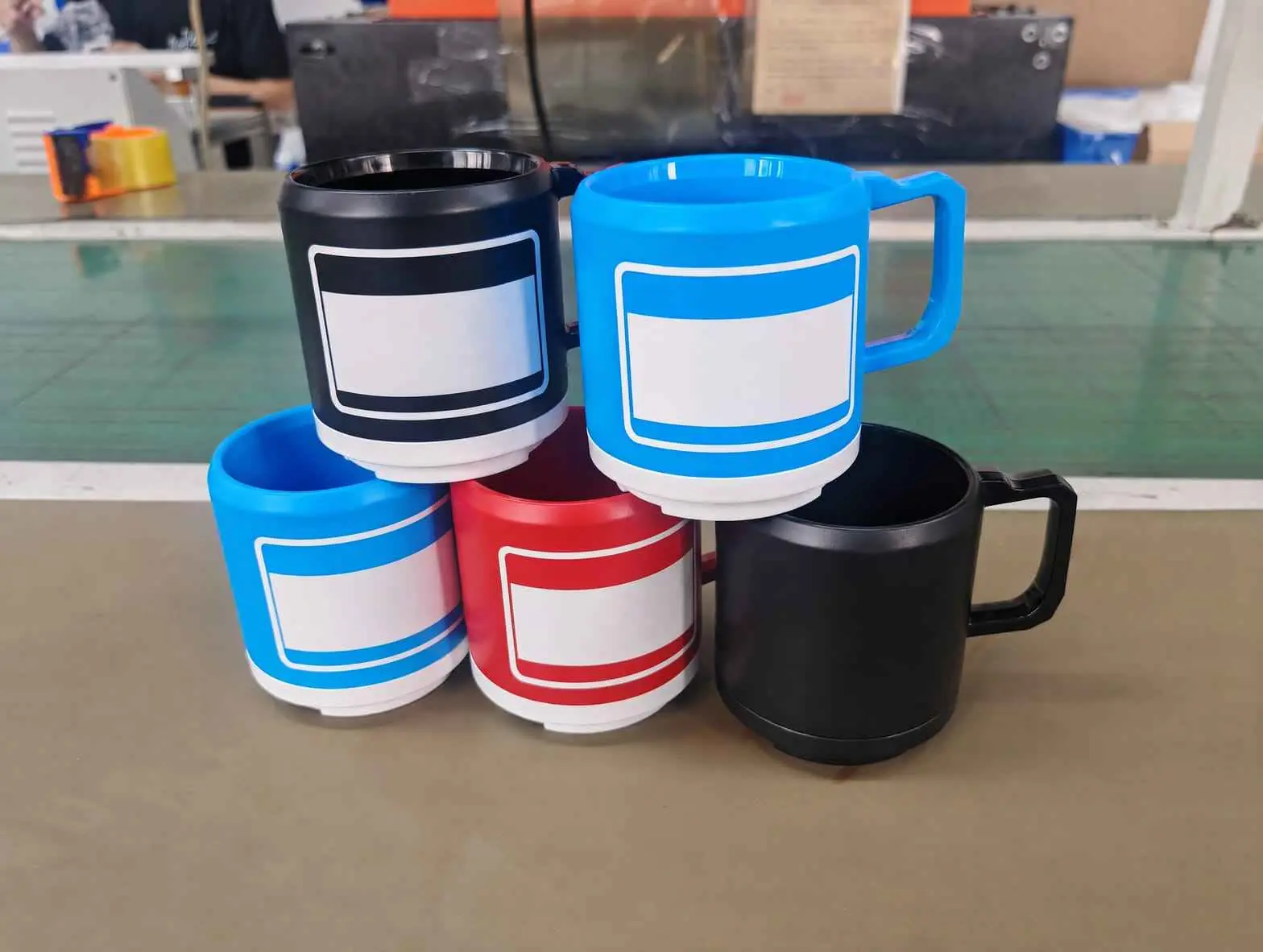
Double Wall PP Mugs: Packing, QC and the Order Journey
A double wall PP mug rarely fails in the customer's hands. It fails in the carton. Scratched shells, rattling bodies, crushed corners and print rubbed off at the contact points are the defects that turn a profitable drinkware order into a claim — and almost all of them are decided in the last two hours of production, not in the mould. This article follows one bulk order of food-grade double wall PP mugs from artwork approval to container loading, and breaks down the four packing steps, the quality checks that happen after the line, and the customisation decisions that hold up in transit.
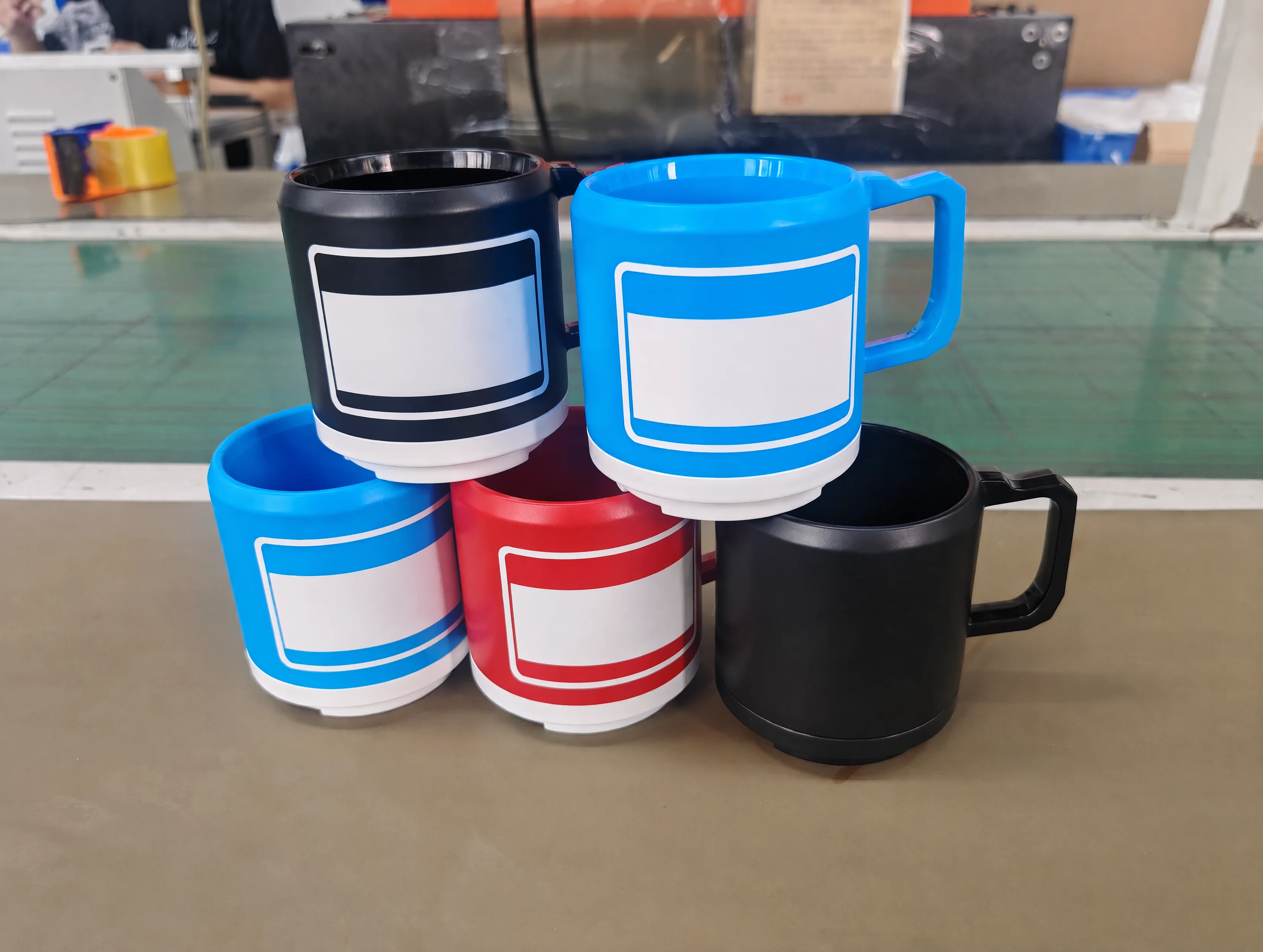
Why Double Wall PP Is the Default Choice for Promotional Drinkware
Polypropylene sits in a useful middle ground for branded drinkware, which is why the wholesale double wall PP mug is the most common brief we receive from promotional buyers. It is food-safe, it is light enough that freight cost per unit stays low, and it tolerates hot drinks far better than polystyrene or standard PLA. On a promotional drinkware programme with a fixed budget per unit and a fixed landed-cost target, that combination is usually what decides the material before the artwork is even discussed.
The double wall construction is what makes it feel like a gift rather than a giveaway. Two shells with an air gap between them insulate the drink, keep condensation off the outside surface, and stop the cup from becoming uncomfortable to hold when it is filled with something hot. It also gives the decoration a flat, rigid panel to sit on, which matters more than most buyers expect.
What the double wall actually does
The gap does three jobs at once: thermal insulation, condensation control and structural stiffness. A single-wall PP mug at the same weight flexes when you squeeze it; a double wall resists that squeeze, which is why the wall thickness of the outer shell can stay modest without the cup feeling cheap.
The trade-off is process complexity. A double wall mug needs two shells, a sealing method between them — usually a press fit, a welded rim or an internal locking ring depending on the tool design — and a leak path that has to be controlled. That is why the same nominal size can feel very different between two suppliers, and why the sample stage matters more for double wall than for single wall.
Where PP hits its limits
Polypropylene is not a premium ceramic substitute and it is not a glass replacement. It scratches more easily than ABS, it will show moulded-in flow marks under raking light if the gate and cooling are not right, and its decoration is only as durable as the ink and the cure behind it. It is also recyclable in the #5 stream where collection exists, which is a genuine point in its favour for retail programmes with a sustainability brief — but only where that stream actually exists.
Being clear about these limits early is how a programme avoids a second-round argument about "quality" that is really about material expectation.
The same tooling and decoration lines also cover 350ml custom logo PP coffee cups, custom BPA free PP plastic tumbler cups and 220ml BPA-free stackable PP plastic mugs, so the specification logic in this article transfers across the range. Single-wall formats such as the 15OZ/420ml reusable plastic drink cup share the same print methods but not the same carton plan — a single-wall mug stacks tighter and needs less internal tooling per carton.
From Artwork to Mass Production: The Five Milestones
Every custom drinkware order runs through the same five gates, and each gate is a place where a supplier can either protect the schedule or quietly compress it. The order behind this article followed that sequence, with photo and short-video updates sent at the packing stage.
- Artwork confirmation — logo files, Pantone references, print size and placement on the curved shell, and which face of the mug is the "front" for retail display.
- Pre-production sample approval — a physical sample in the final colour and print, signed off before the tool runs at volume — the custom moulding stage where most schedule risk is created or removed.
- Mass production — moulding, assembly of the two shells, decoration, then curing before packing.
- Inspection before packing — appearance, print quality and fit checked against the approved sample, plus a packing-tightness check on the finished carton.
- Shipment — carton sealing, palletising and container loading, with the packing record shared back to the buyer.
The gate that buyers most often skip is number two. Approving a pre-production sample from a photograph rather than a physical part is the single most reliable way to end up with a colour that reads wrong under retail lighting, or a print that sits two millimetres off the handle side.
Packing Engineering: What Stops Scratches in an Ocean Container
Everything upstream of this point is wasted if the carton does not survive four weeks at sea. The packing sequence for this order was deliberately conservative, because the cost of a claim is always higher than the cost of the packing material.
Step 1 — individual protective wrapping
Every mug is wrapped individually before it goes anywhere near a carton. The purpose is not cushioning; it is friction control. Two PP shells in direct contact will polish each other's surface within a few hundred kilometres of road vibration, and the marks appear exactly on the panel where the logo sits.
Wrapping also protects the print during handling. A mug that is unwrapped and re-stacked three times on a packing bench will pick up thumb rubs on the ink long before it reaches a container.
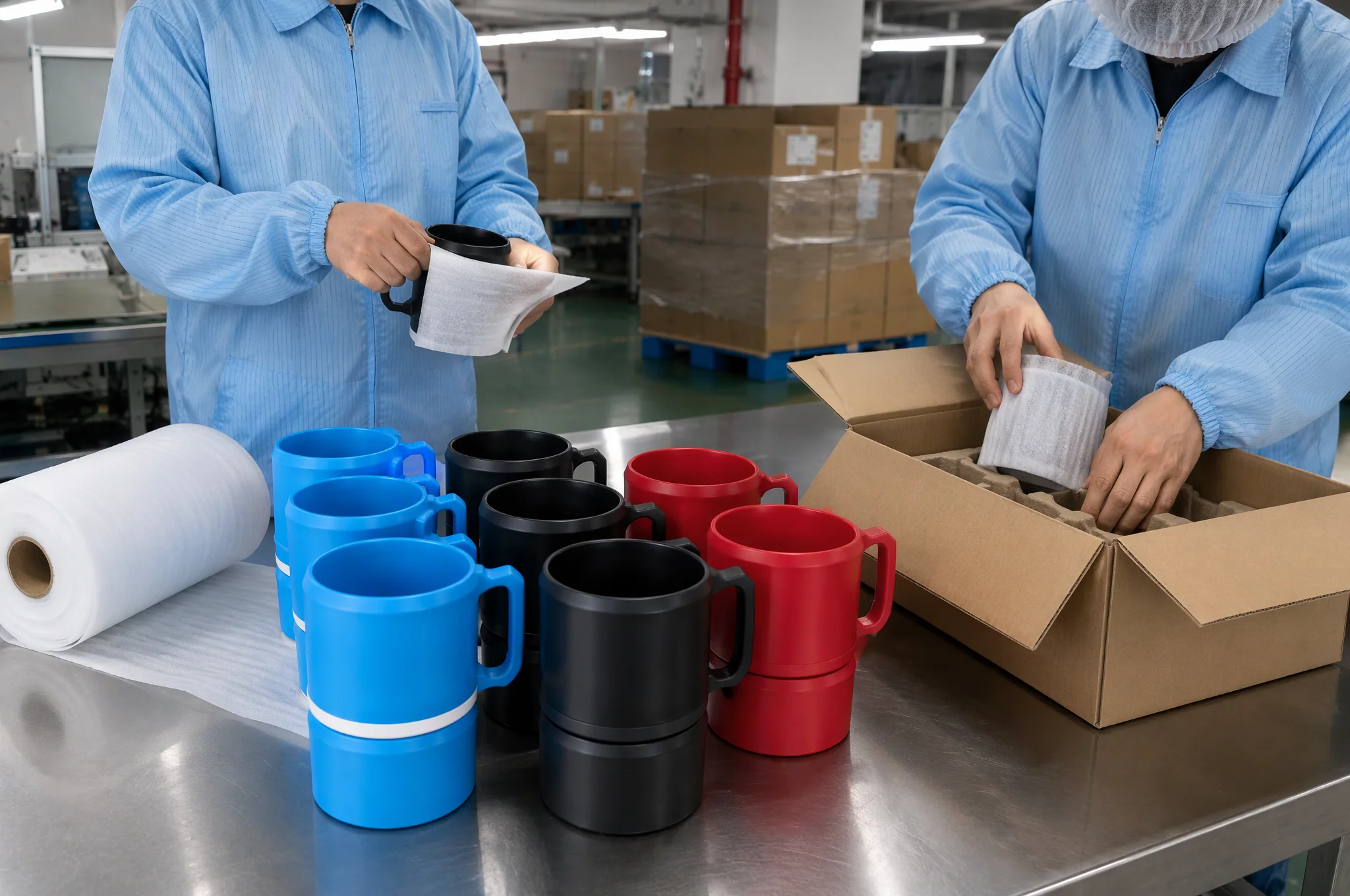
Step 2 — inner layout that fixes position
Individual wrapping stops surface damage; the inner layout stops movement. Cells, dividers or a moulded insert hold each mug in a fixed orientation so that nothing can shift into a neighbour when the carton is tipped during loading or stacked in transit.
The layout also decides how the carton behaves under compression. A carton packed with a consistent internal grid carries load through the dividers; a carton with slack carries it through the mugs. That difference only shows up after a few weeks under other pallets.
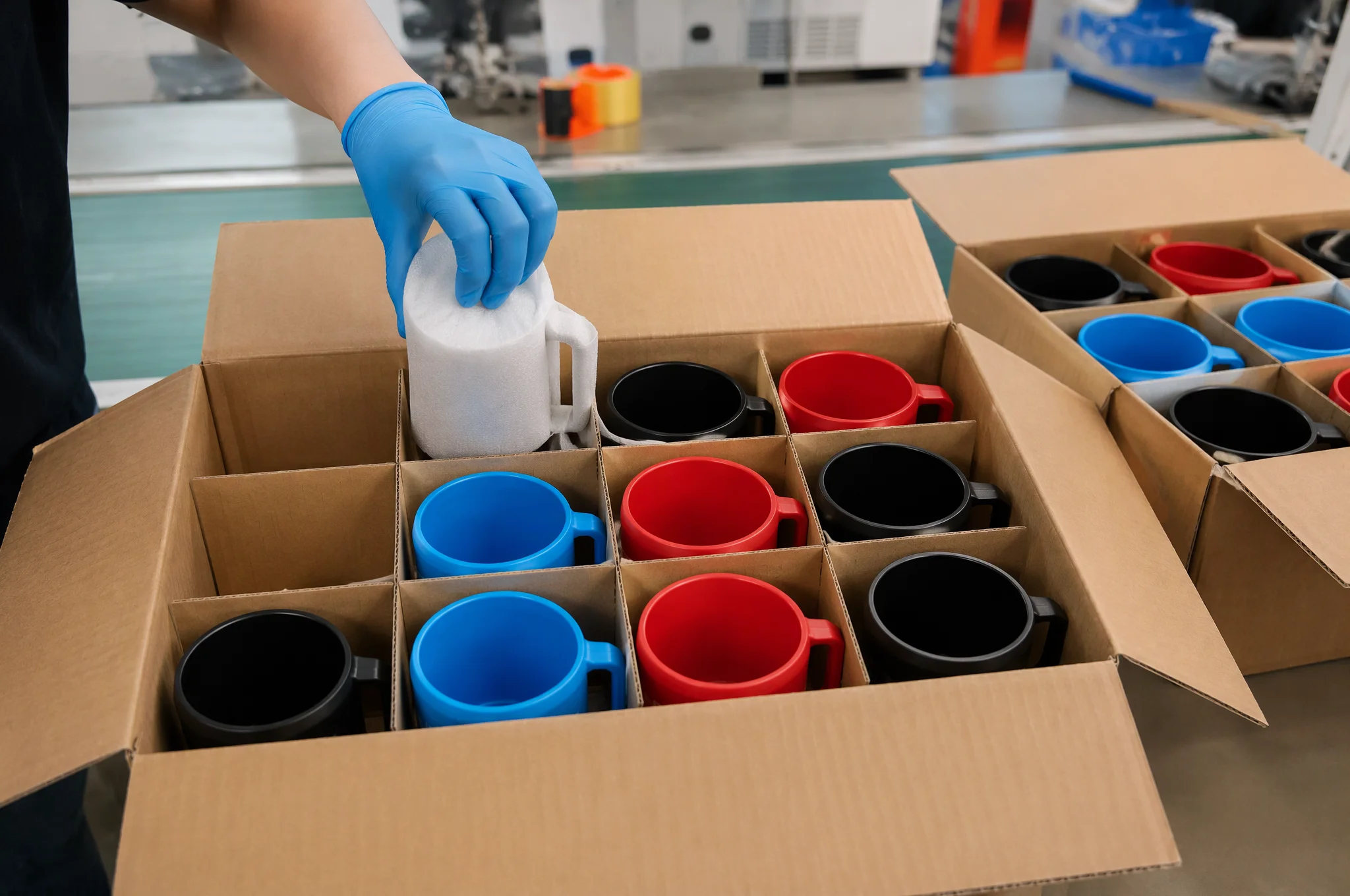
Step 3 — cartons built for sea freight
Export cartons for drinkware need more than a standard single-wall board. The specification that matters is compression strength against stacking height, plus moisture resistance for a container that will cross several climate zones.
Container rain — condensation forming on the underside of the roof as the box moves between climates — is a real risk for paper packaging. It is managed with board grade, with desiccant where the route justifies it, and with a loading plan that keeps cartons off the container floor.
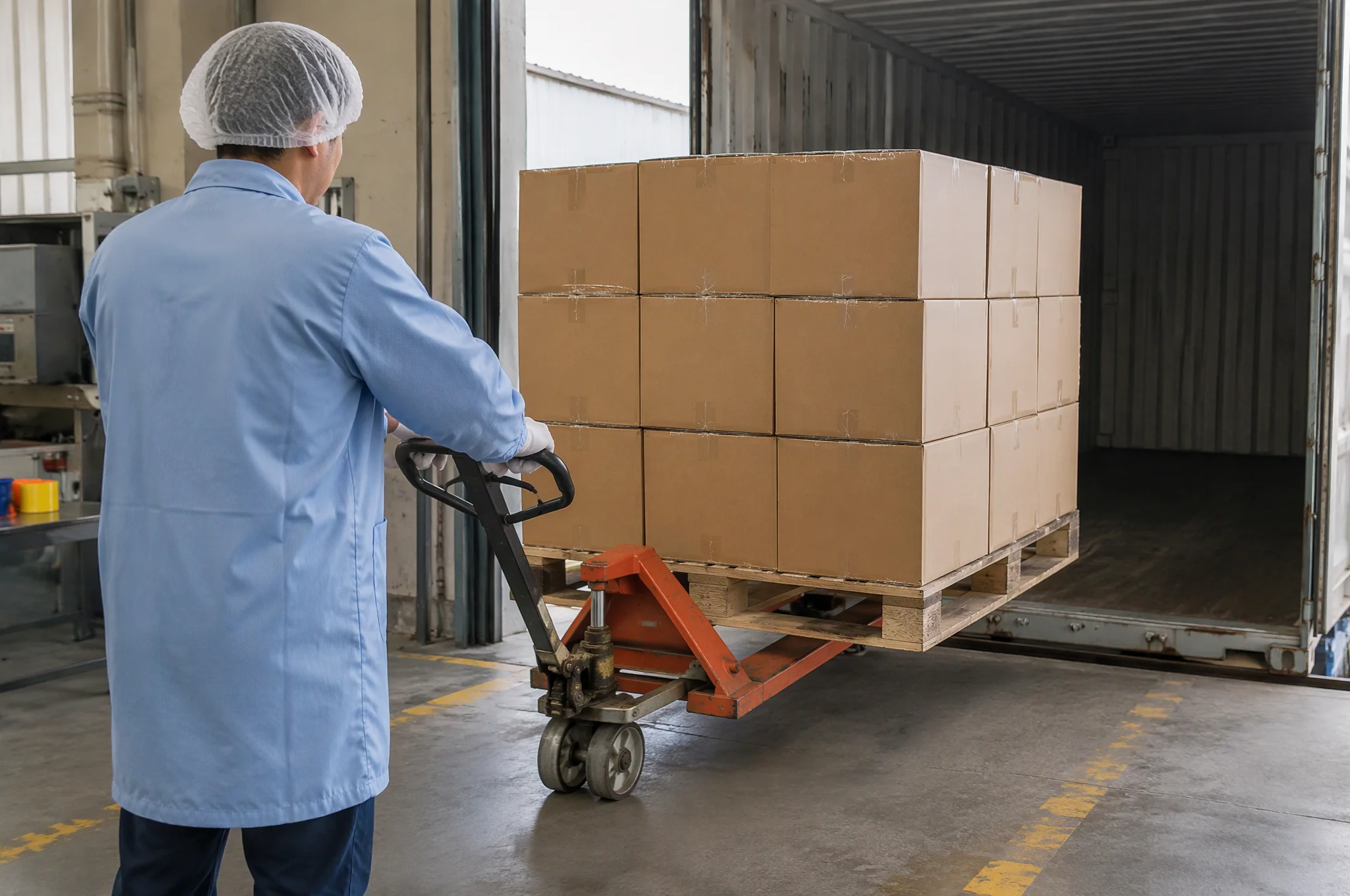
Step 4 — final sorting and loading
The last step is the one most often done in a hurry. Cartons are sorted by colour and by artwork version before loading, so that a mixed pallet does not become a mixed carton, and the loading sequence keeps the heavier stack at the bottom.
A loading photo set taken at this point is worth keeping. If a dispute arises later about carton condition, the evidence is in that folder, not in an email thread.
Quality Control That Happens After the Production Line
The QC that protects a drinkware order is not the inline inspection, it is the one that happens when the goods are already packed. At this stage the question changes from "is the part good" to "is the shipment good", and three things get checked.
Appearance. Every carton is opened and a sample is pulled for surface inspection under consistent lighting: scratches, flow marks, sink marks around the handle root, colour variation between cavities and between batches.
Printing. Registration against the approved sample, ink coverage on the curved surface, and adhesion at the edges where the print meets the radius. A rub test on a sample from each print run catches the under-cured batch that would otherwise fail in the field.
Packing tightness. The carton is closed, shaken and dropped from handling height on a corner and an edge. If the inner layout shifts, it shows up here rather than in the customer's warehouse.
The sampling logic is usually a standard AQL plan with a tightened level for critical defects, run by the in-house QC team rather than an external party. What matters for a buyer is not the letter of the standard but whether the supplier can show the record: the defect classification, the sample size, and what was done with the rejects.
Custom Logo and Colour on PP: What Actually Works
Decoration is where a custom printed PP mug programme is won or lost, because the logo is the entire reason the buyer is ordering. PP accepts several print methods, and they do not wear the same way.
Print methods compared
Silk screen is the standard for solid single-colour artwork and large fill areas, such as a name-label block. It gives strong opacity on a coloured shell and the lowest unit cost at volume, but each colour is a separate screen and a separate pass.
Pad printing handles small multi-colour logos and fine detail on curved surfaces, at a higher unit cost with lower tooling. It is the usual choice when the artwork has several colours in a compact lockup.
Heat transfer carries photographic or gradient artwork that screen printing cannot reproduce, and wraps well around a curve, but the film edge is the wear point.
Laser marking produces a permanent mark that cannot be washed or peeled, at the highest unit cost and in a single tone. For a mug that will be handled daily, it is the most durable answer.
Pantone matching on PP
Colour on PP is not colour on paper. The resin base, the masterbatch and the wall thickness all shift the final appearance, and a double wall mug shows the shift twice — once on the shell, once through the gap when the light comes from behind.
Approve colour from a moulded chip or a sprayed sample, never from a screen. Expect one correction round, and get the approved chip signed and kept with the order file so that a repeat order six months later has something to match against.
The Failure Modes That Generate Claims
Most claims on drinkware shipments fall into five categories, and none of them are mysterious.
Surface scratches from unwrapped contact. Rattling damage from an inner layout with slack. Carton crush from a board grade specified for warehouse stacking rather than for a container. Print loss at the thumb contact point, from ink that was never cured to a specification. Colour mismatch between the approved sample and the bulk run, usually because the masterbatch changed and nobody re-approved.
Each one has a cheap prevention and an expensive remedy. The prevention is always a written packing specification and a signed sample, both of which cost nothing to produce at the quotation stage. The remedy is rarely the replacement cost alone: it is the air freight for the urgent top-up, the rework labour at the destination, and the shelf date a retail buyer loses while the carton sits in a return bay. That is why the packing record matters as much as the inspection result — a claim that can be traced to a documented process is a different conversation from one that cannot be traced at all.
What Drives Cost and Lead Time
Buyers often treat quotation differences as negotiation room. In a custom logo PP mug quotation they are usually a specification difference, and it is worth knowing which lever moves what.
Tooling is the fixed cost, and it scales with the number of colours and the complexity of the shell rather than with volume. Print set-up is per colour per run. Packing specification is the quiet one: individual wrapping, cells and dividers all add labour, and labour is what actually moves a ship date when a factory is busy.
Lead time is driven by the sample round and the print cure, not by moulding. A programme that approves the pre-production sample in one round typically ships on schedule; one that needs three colour corrections absorbs the whole buffer before production starts. Packing and freight also have to be costed together, because a carton specified for pallet shipping and a carton specified for individual parcel despatch are different products at the same unit price. Comparing quotations line by line — tooling, print set-up, packing, carton grade — is the only way to see whether a lower price is a cheaper specification rather than a better deal.
FAQ
Are double wall PP mugs safe for hot drinks? Food-grade PP is the standard material for hot drink service in promotional drinkware. The double wall keeps the outside comfortable and reduces condensation, and the temperature limit should come from the supplier's material datasheet rather than from a marketing page.
Can the mugs go in a dishwasher? The body usually can, at low temperature. The print is the variable — screen print and heat transfer degrade faster than laser marking under repeated hot cycles, so specify the wash cycle you intend to claim and test the decorated part, not the bare mug.
How are double wall mugs sealed? Depending on the tool design, the two shells are joined by a press fit, a welded rim or an internal locking ring. The method affects leak resistance and the look of the rim seam, and it should be visible in the pre-production sample you approve.
What is the minimum order for a custom colour? It depends on the masterbatch and the tool, and it is one of the few numbers worth asking for directly rather than assuming. Custom colour, custom print and custom packing are usually quoted as three separate thresholds.
Can you pack to our retail carton specification? Yes — retail-ready cartons, private-label sleeves and mixed-colour assortments are all quoted as packing options, and they change the labour content rather than the product cost.
What evidence do we get that the packing was done properly? Ask for the packing-stage photo and video record, the carton drop-test result and the inspection report with defect classification. A supplier who documents packing will share it without being asked twice.
What to Send for a Quote
A drinkware quotation is only as precise as the brief behind it. Send the volume by colour and by artwork version, the print method you are targeting, the carton format your customer requires, and the destination port so that packing and freight can be costed together rather than separately.
It also helps to say what the mugs are for. A promotional giveaway, a retail shelf programme and a corporate gift set have different tolerance for lead time and different expectations of the carton, and the same mug can be quoted three ways depending on which one you are buying. Send the destination port as well: packing decisions that look free in a quotation are often the ones that change the freight calculation. If you are still choosing between single wall and double wall, or between PP and a compostable material for a specific retail programme, send the brief to our team and we will tell you where the material stops — including the cases where PP is the wrong answer.